
Brand Pyramid
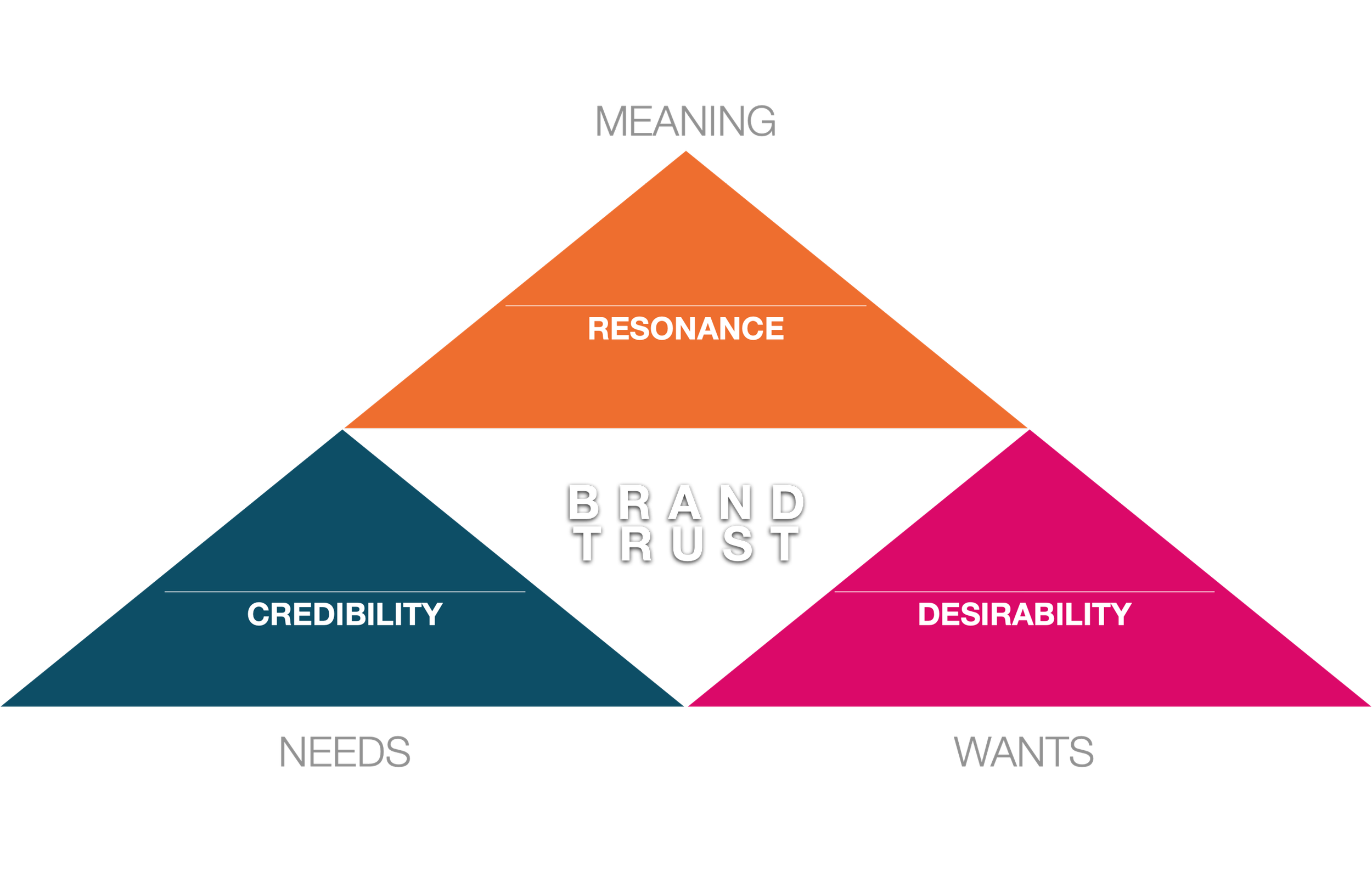
When I began working with CEOs on brand design strategy in China in 2009, I quickly noticed a recurring problem. While many definitions of branding sounded smart (a brand is a promise, a brand is a gut feeling, and so on), decision-makers did not feel guided by that kind of advice. What they wanted to know was what makes a brand strong, what makes it weak, and what can be done about it.
That is when I came up with the Brand Pyramid.
It is a simple framework built around three structural levers: Credibility, Desirability, and Resonance. Together, these three dimensions generate what every serious brand ultimately needs: trust. And when trust is sustained over time, it generates something even more valuable: loyalty.
The framework is made of three supporting triangles shaped like a pyramid for a reason. A strong brand is not an accumulation of random marketing gestures or curated “impressions.” It is a metaphysical structure. And like architecture, it must stand up under various business conditions. And like design, it must balance function, elegance, and meaning.
First triangle: CREDIBILITY
Can I trust you to do the job?
At its most basic level, credibility is the proof that a company is real, capable, and lawful. It can deliver what it promises. It has experience, assets, references, partnerships, and a track record. It operates with enough consistency to reassure customers, investors, employees, and institutions.
Without credibility, there is no brand. There is not even a viable business.
This is particularly visible in B2B environments. Many companies that sell services, industrial products, or infrastructure solutions put almost all their branding investments into showing that they are serious, compliant, experienced, and technically competent. In some sectors, this is understandable. If you provide energy systems, medical equipment, logistics, or cybersecurity, people must first believe that you can perform.
Credibility is driven by need. It answers a practical question: can I rely on you for something important? It belongs to the realm of survival, continuity, and operational security.
From a brand design standpoint, credibility is expressed through form, typography, tone of voice, clarity, precision, visual consistency, and freedom from mistakes. The skillful practice of design, here, translates competence into perception by a demonstration of professionalism.
Second triangle: DESIRABILITY
do I want what you offer?
If credibility makes a brand reliable, desirability makes it attractive. It makes people want to buy, join, try, wear, recommend, or even simply talk about what a company offers.
This is where many classic branding cases live, especially in B2C markets. If a company sells beverages, fashion, cosmetics, devices, or hospitality, it cannot survive on functional reliability alone since many if not all, competitors are equally capable.
Desirability is, at its core, a principle of differentiation. It may come from sensory pleasure, elegance, storytelling, symbolism, packaging, naming, aspiration, status, or emotional charge. This is where branding often overlaps with marketing, and where the two are frequently confused. Marketing can stimulate desire for a specific product. Branding, more deeply, makes the company itself desirable, so that future offerings begin with an advantage.
That is why some brands can extend into new categories relatively easily. Their desirability travels ahead of the product.
Desirability is driven by want. It belongs to the realm of attraction, freedom, projection, and imagination. It is powerful, but it can also be superficial if it is not anchored in something more substantial. A brand built only on desire may shine brightly for a while, then fade as quickly as attention shifts.
From a design perspective, desirability is where expression becomes strategic. The designer is not merely styling an object or a campaign. They are shaping and articulating the cultural conditions through which a business becomes more compelling, more competitive, and more memorable.
Third triangle: RESONANCE
do I believe in what you stand for?
This third triangle is in my view the most powerful one.
Resonance occurs when a brand connects with people not only through utility or attraction, but through shared values. Customers, employees, and stakeholders feel that the brand stands for something they recognize in themselves. The alignment may be moral, philosophical, cultural, or existential. At that point, the relationship deepens. The brand is no longer just useful or appealing. It becomes meaningful.
This is why some brands inspire exceptional loyalty. People remain attached not because the brand is the cheapest, or even always the best, but because it expresses a worldview they want to belong to. The brand becomes a marker of identity.
Resonance is driven by the search for meaning.
This part of branding is often neglected because it is harder to quantify and harder to fake. Yet it is also where the greatest long-term value is created. When resonance is genuine, trust becomes far more resilient. Employees commit more deeply. Customers forgive occasional errors. Stakeholders defend the brand because they feel implicated in what it represents.
This is where branding moves beyond promotion and enters the territory of leadership. A resonant brand is not simply well positioned in the market. It is anchored in purpose, principles, and vision. It turns alignment into an intangible asset.
For designers, resonance is where form, language, and behavior must become coherent. It is not enough to claim values. A brand must embody them across touchpoints, decisions, services, environments, and internal culture. Design makes visible and tangible what would otherwise remain words.
Between these three triangles, trust emerges.
Trust does not arise from credibility alone, although credibility is necessary. Nor does it arise from desirability alone, although desire can accelerate attention and adoption. Trust appears when these dimensions reinforce one another and are amplified by resonance.
When all three are significantly present, trust becomes stronger than any P.R. campaign could inspire. It becomes a durable relationship. And when trust is renewed over time, it leads to loyalty.
Loyalty is not just repeat purchase. It is the willingness to return, remain, recommend, and even defend. In business terms, it reduces acquisition costs, stabilizes value, and increases resilience.
This Brand Pyramid can also be used as both an analytical and a design tool.
It helps evaluate a brand: Is it credible but dull? Desirable but shallow? Resonant in discourse but weak in proof? Many brands are overdeveloped in one triangle and underdeveloped in another. The framework clarifies that imbalance.
It also helps define action: Once we understand where the weakness lies, we can begin designing more intelligently. Perhaps the company needs stronger signals of legitimacy and capability. Perhaps it needs a more distinctive and compelling expression. Perhaps it needs to clarify its purpose and translate its values into a coherent experience.
The Brand Pyramid is therefore a working model for building brands that are structurally sound, commercially smarter, and capable of earning trust in a world crowded with fakes and pretensions. To me, it is a foundational tool for designing trust.